Types of Castells: complete guide to human tower structures
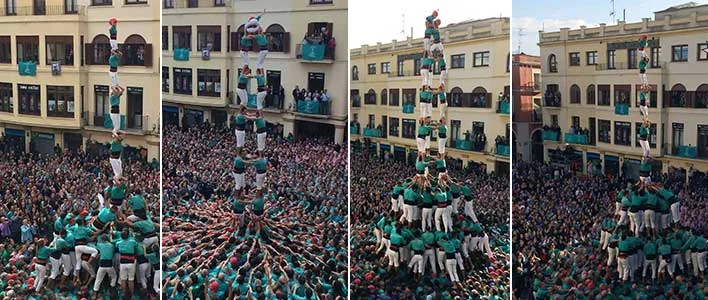
The casteller world contains an enormous variety of structures, each with its own name, technique and level of difficulty. From the simplest pilar to imposing ten-storey constructions, every castell is the result of collective work that combines strength, balance and coordination. Understanding the different types of castells is key to appreciating the richness of this tradition, now recognised as Intangible Cultural Heritage of Humanity.
All casteller structures follow a naming system that makes them easy to identify. Below, we explain how that system works and review the main families of castells: from simple structures to composite ones, as well as the variants and extra support elements that make ever taller constructions possible.
How to read a castell's name
A castell name follows the formula "X de Y", where X is the number of castellers on each level of the trunk, excluding the pom de dalt, and Y is the total number of levels from the baixos up to the enxaneta, without counting the pinya. For example, a 4 de 8 is a castell with four people on each level of the trunk and a total height of eight levels. When the enxaneta reaches the top and raises a hand, the castell is considered loaded. If it is then dismantled completely without collapsing, it is considered unloaded.
Simple structures
Simple structures are those in which every level of the trunk is made up of a fixed and relatively small number of people. They form the basis of the casteller repertoire and are the first structures most colles learn, although some of their taller variants are among the most difficult castells in the world.
Pilar
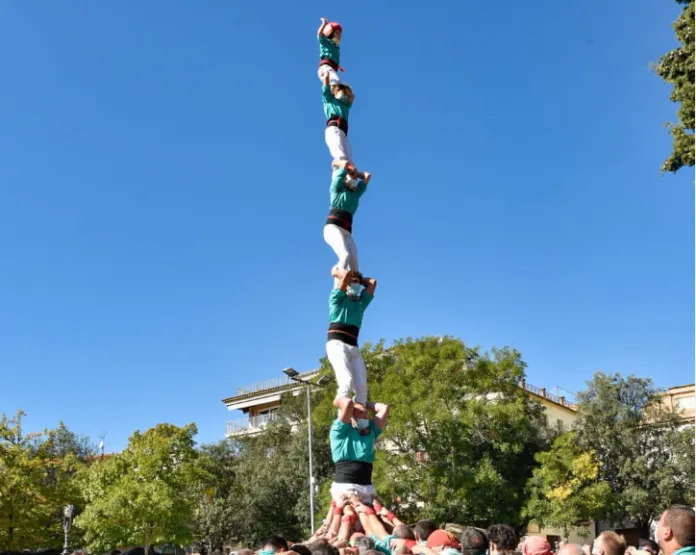
The pilar is the most basic structure: a single person on each level, stacked vertically. Despite its apparent simplicity, it is paradoxically one of the hardest castells, because each casteller must bear the full weight without any lateral support, relying entirely on balance. Common variants are the pilar de 4, 5, 6 and 7. Unlike most other castells, a pilar does not have the conventional pom de dalt of dosos, acotxador and enxaneta; it is crowned by a single person.
Torre (or dos)
The torre, also known as a dos, is a structure with two people on each level of the trunk. It offers more stability than a pilar thanks to the mutual support between the two castellers on each level. The most common variants are the torre de 6, 7, 8 and 9. Tall torres require a very solid pinya and highly refined technique.
Tres
Tres castells have three people on each level of the trunk, arranged in a triangular shape. This gives them a broader base and allows them to reach considerable heights. The main variants are the 3 de 7, 3 de 8, 3 de 9 and the exceptional 3 de 10, one of the highest-difficulty structures in casteller history.
Four
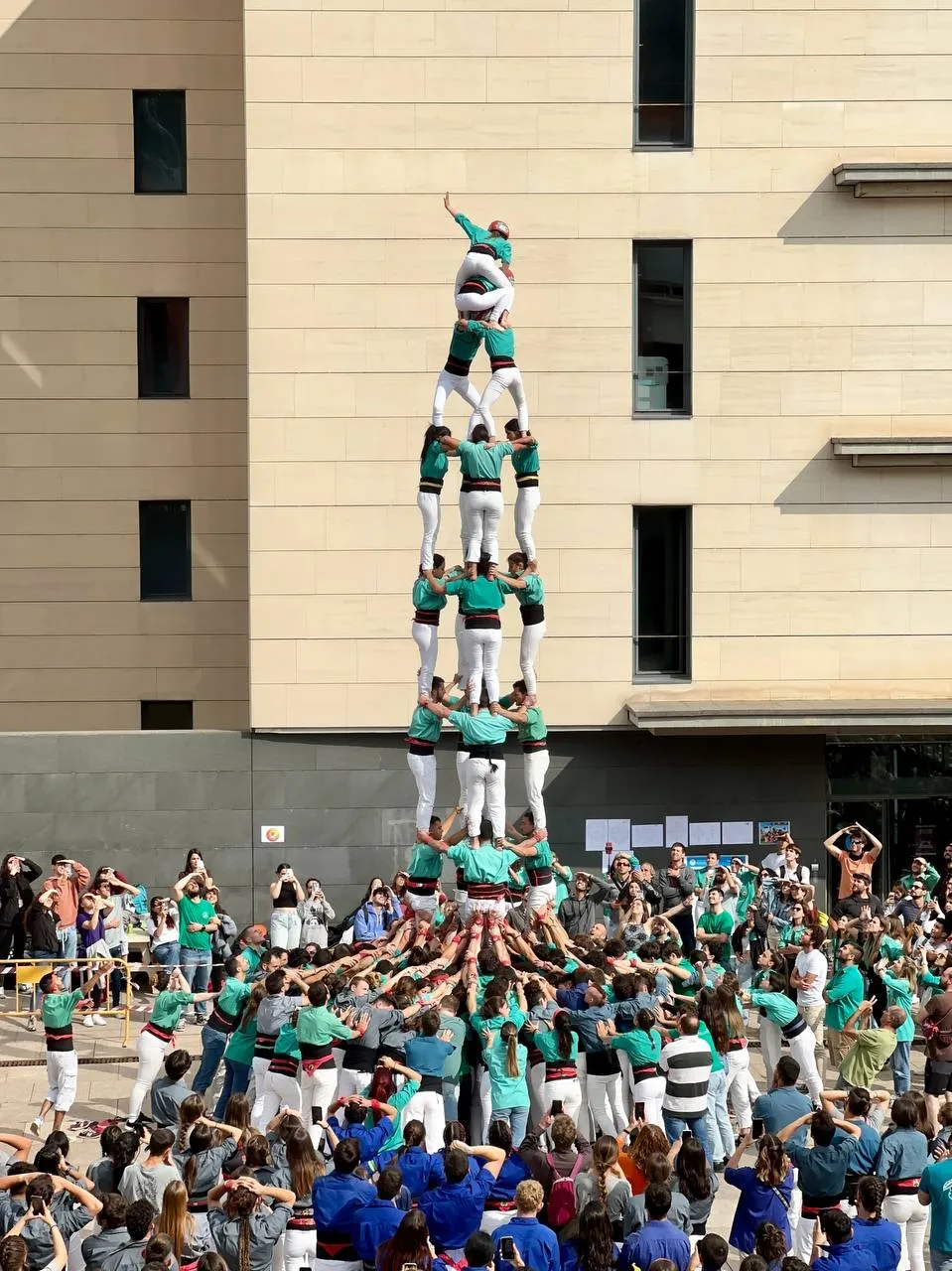
Four-person castells are the most common structures in casteller performances. With four people on each level arranged in a square, they offer great stability and can reach impressive heights. Variants range from the 4 de 7, common among many colles, to the 4 de 8 and 4 de 9. The 4 de 10 amb folre i manilles, first unloaded in 2015, is one of the most difficult and iconic castells in history and remains a milestone reserved for the strongest colles.
Composite structures
Composite structures are castells in which the trunk combines groups of different widths, creating more complex forms. They are usually massive constructions that require a large number of participants and exceptional coordination.
Cinc
A cinc has five people on each level of the trunk, arranged as a 3+2 combination. It is a transitional structure between simple castells and the largest composite ones, and it poses a serious challenge both in terms of balance and coordination.
Set
A set combines seven people on each level, 4+3, creating a broad and imposing structure. It requires a very large pinya and a high number of castellers both in the trunk and at the base. It is a castell usually reserved for major occasions and highly experienced colles.
Nou
A nou has nine people on each level, 5+4, and is one of the largest structures in the casteller repertoire. Building one requires an enormous pinya and hundreds of people working in perfect synchrony. Only the biggest and most experienced colles attempt it.
Deu i dotze
Castells with ten and twelve people per level are the most monumental structures of all. They are exceptional constructions that appear only rarely and are reserved for very special occasions. Their logistical complexity and the sheer number of castellers required make them events in themselves within the casteller calendar.
Variants and complements
As castells grow taller, extra structural elements must be added to reinforce the base and provide stability to the whole construction. These variants and support systems are essential to make the tallest castells possible.
Amb folre (with folre)
The folre is an additional support layer placed above the pinya around the first levels of the trunk. It is used in castells of 8 levels or more to spread the load and give extra support to the trunk. A castell "with folre" adds hundreds of kilos of extra support to the structure.
Amb manilles (with manilles)
The manilles are a second additional support layer, placed between the folre and the trunk. They are used in 9- and 10-storey castells, where the weight becomes so great that extra reinforcement is essential. When a castell has both folre and manilles, the total number of people involved at the base can exceed two hundred.
Amb agulla (with agulla)
An agulla is an inner pilar built inside the trunk of the castell to provide extra stability. It acts like an internal spine, helping distribute weight and keep the whole structure straight, especially in very tall or wide castells.
Aixecat per sota (raised from below)
Aixecat per sota is a building technique in which the castell is assembled from the bottom upwards, without anyone climbing the outside of the structure. Each level is lifted from ground level, passing beneath the levels already in place. It is a spectacular and highly difficult technique that shows exceptional technical control.
Difficulty scale
The difficulty of a castell depends mainly on its height, the number of levels, and to a lesser extent on the width of the trunk. Beginner colles start with pilars de 4 and 4 de 6 castells, then progress toward torres de 7 and 3 de 7 and 4 de 7 castells. The jump to eight levels is a turning point: castells with folre require much more people and much more technique. Nine-storey castells, with folre and manilles, are the target for high-level colles, while 10-storey castells represent the absolute summit. The first 3 de 10 amb folre i manilles was unloaded in 1998 and the first 4 de 10 amb folre i manilles in 2015. Today, only a handful of colles are capable of attempting 10-storey castells.
History of castells and their records →
Which castells are performed at corporate events?
For corporate events, castells are adapted to the available space and to the kind of experience the organiser wants to offer. The most common structures are pilars, fast and visually striking, torres, and 3- or 4-person castells adapted to the venue's height. In general, two options are offered: a team of 25 castellers able to build structures of up to 4.5 metres, or a team of 40 people capable of raising structures of up to 6 metres.
Whatever the size of the castell, the experience always includes public participation in the pinya, turning attendees into an active part of the build. It is a unique team-building activity that conveys the values of trust, cooperation and collective achievement that define the casteller world.
Book castells for your event →