History of Castells: from Valls to World Heritage
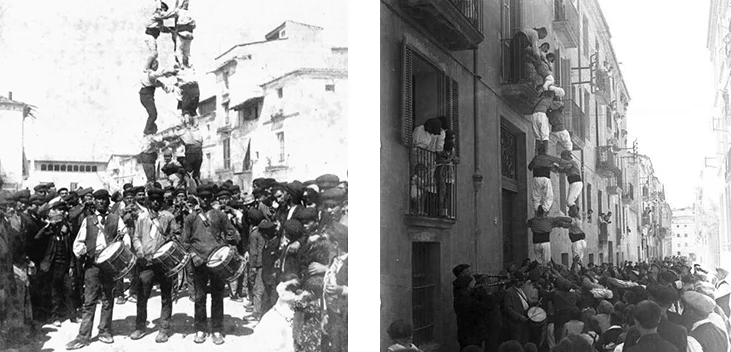
More than 200 years of history separate the first human towers raised in Valls, in the Camp de Tarragona area, from the inscription of castells as Intangible Cultural Heritage of Humanity by UNESCO in 2010. Over that long journey, castells evolved from one element within a religious dance into one of the strongest cultural symbols of Catalonia and a practice now embraced by people around the world.
The story of castells is one of collective identity, resilience in the face of repression and constant self-improvement. It is a tradition that has survived wars, dictatorships and deep social change, and every time it seemed close to disappearing it returned with even greater strength. To understand its history is to understand a way of building community unlike anything else in the world.
Origins: the Ball dels Valencians (18th century)
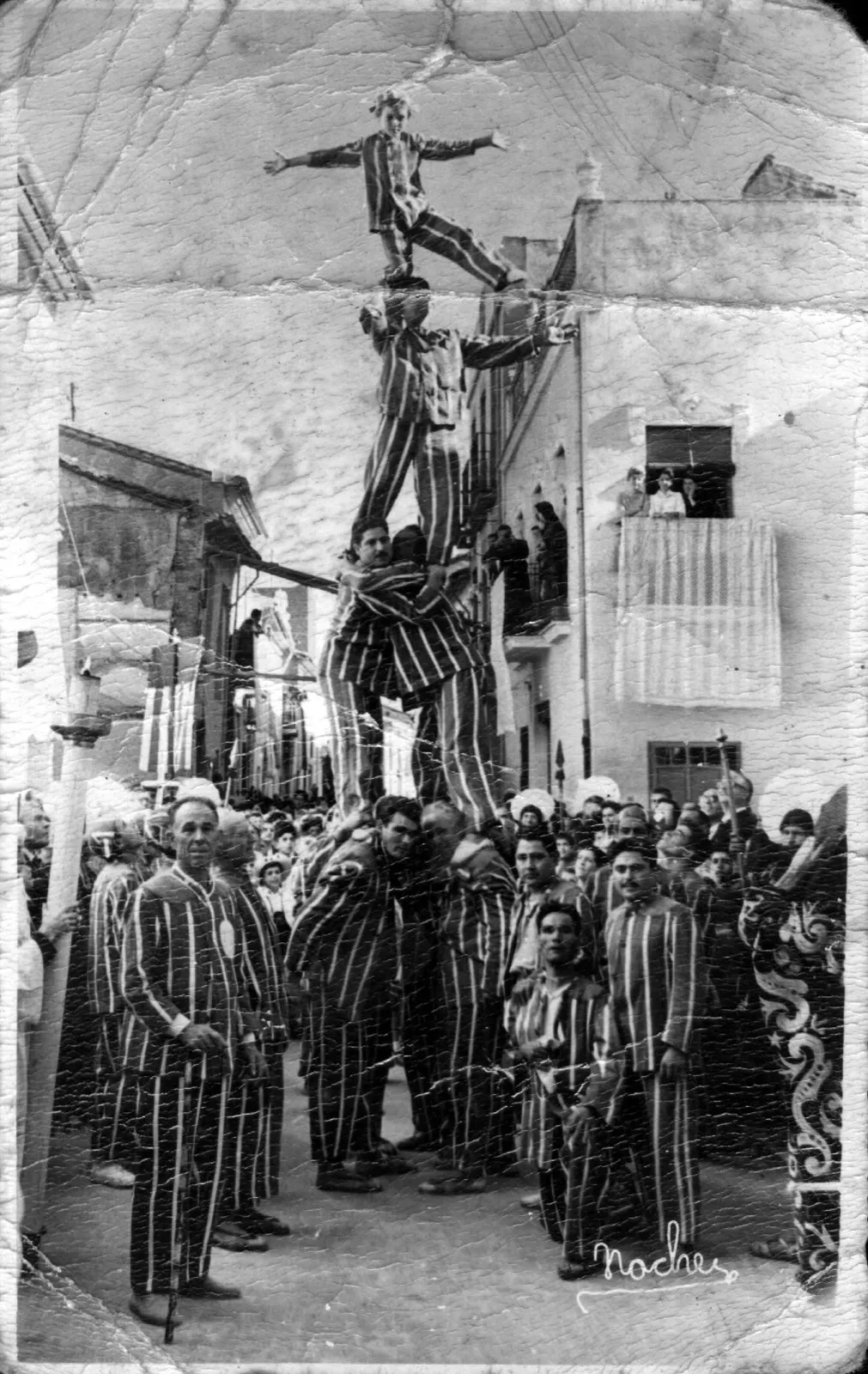
The origin of castells lies in the Valencian Muixeranga, a processional dance still performed today in Algemesi during the festival of the Mare de Deu de la Salut. That dance included human towers as a symbolic and religious element, and it probably reached the Camp de Tarragona area through the festive and commercial routes linking Valencia and Catalonia.
In Valls, the dance became known as the Ball dels Valencians. The earliest documented references date from 1712, when human towers were already mentioned in the context of local festivities. Over time, the acrobatic element, the towers themselves, gained prominence until it fully detached from the original dance and became an independent practice.
That separation did not happen overnight. Throughout the 18th century, the towers became taller and more complex, and the groups building them began to compete with one another. The competitive spirit that still drives the casteller world today was present from the beginning. By the end of the century, Valls already had two rival colles fighting for supremacy at every major festival.
That is how a unique tradition was born: human constructions in which dozens of people trust one another to achieve a collective goal. With no support beyond their own bodies, no safety net, and only strength, balance and technique to rely on.
Expansion across Camp de Tarragona and Penedès (19th century)
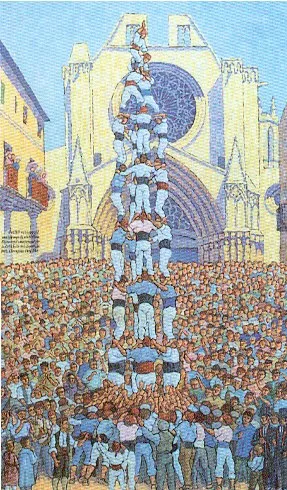
During the 19th century, castells experienced their first major territorial expansion. From Valls, the tradition spread to Vilafranca del Penedes, Tarragona and other nearby towns. Every place that adopted castells gave them its own character and ambition, and before long new colles emerged that rivalled one another not only within the same town, but across different communities.
In Valls, the rivalry between the great local colles, historical predecessors of today's Colla Vella dels Xiquets de Valls and Colla Joves Xiquets de Valls, became the main engine of casteller progress. That competition pushed both groups to reach previously unseen milestones: the first eight-storey castells and, by the end of the century, the first nine-storey ones. Every achievement by one colla forced the other to go further, in an upward spiral that defined the character of the casteller world.
Castells became deeply rooted in Catalan town festivals. Building them stopped being mere entertainment and became an act of local identity and shared pride. Casteller performances became central moments in the festive calendar, and the colles took on a social role that went far beyond acrobatics: they were, and still are, spaces of coexistence, cultural transmission and social cohesion.
Decline and resistance (first half of 20th century)
The first half of the 20th century was the hardest period in casteller history. The Spanish Civil War (1936-1939) broke up the colles: many castellers went to the front, others were forced into exile, and festive activity came to a complete stop during the conflict. The war did not only destroy lives; it also destroyed the social fabric that made castells possible.
Before the war, however, there had been a moment of hope: in 1932 Tarragona hosted the first Concurs de Castells, with Pau Casals serving as jury president. A second edition followed in 1933 and, after the war, the event reappeared intermittently until the city re-established it from 1970 onwards. The Concurs de Castells de Tarragona →
Under Francoism, castells survived, but in very precarious conditions. The regime repressed Catalan cultural expression and, although castells were not explicitly banned, they lost much of their festive context and their identity-based meaning. The colles were reduced to a minimum, with few members and little technical ambition. It was a time of silent resistance, when keeping the tradition alive was already an act of courage.
The renaissance (1960-1980)
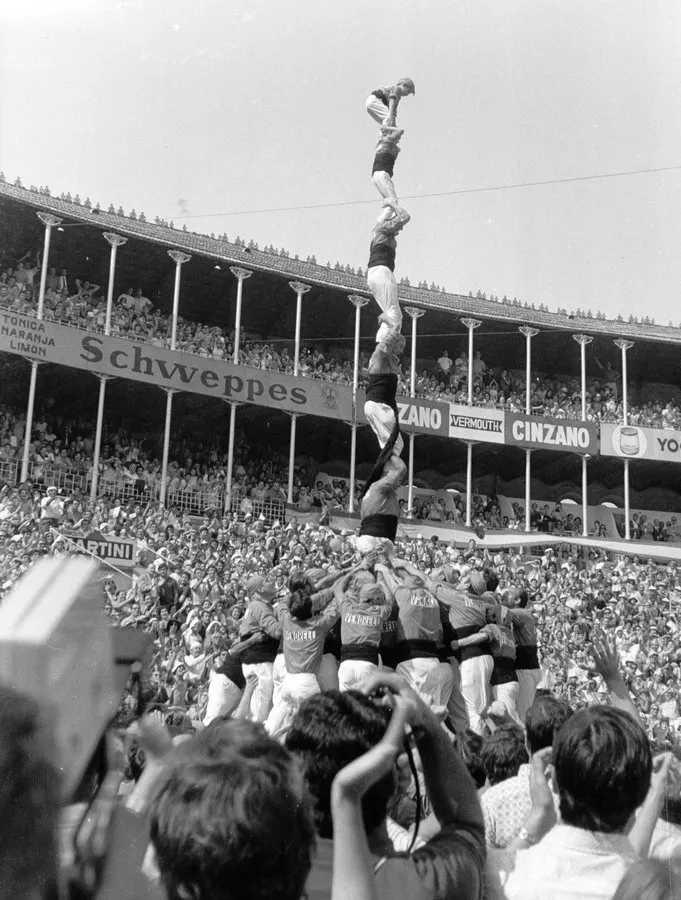
From the 1960s onward, the casteller world began a slow but steady recovery. New colles were created in towns with no previous casteller tradition, and the public returned to the squares. But the real turning point came with the 1970 Concurs de Castells, popularly known as "the concours of the century". That edition marked the definitive recovery of the tradition: the colles achieved technical milestones unseen for decades, and castells once again took a central place in Catalan cultural life.
The 1970s brought sustained growth: new colles, new audiences and new ambitions. But the deepest revolution arrived in the 1980s with the incorporation of women into the casteller world. Until then, castells had been a largely male environment. The inclusion of women was a major social and technical shift.
Women brought lighter weights to the upper levels of the structures, opening technical possibilities that had previously seemed unimaginable. More importantly, their participation transformed the colles into mixed, intergenerational spaces that were far more open and representative of society. New mixed colles were founded across the country, and older ones integrated women at every level of the structure. That quiet revolution was the seed of the golden age that was about to arrive.
The golden age (1990-present)
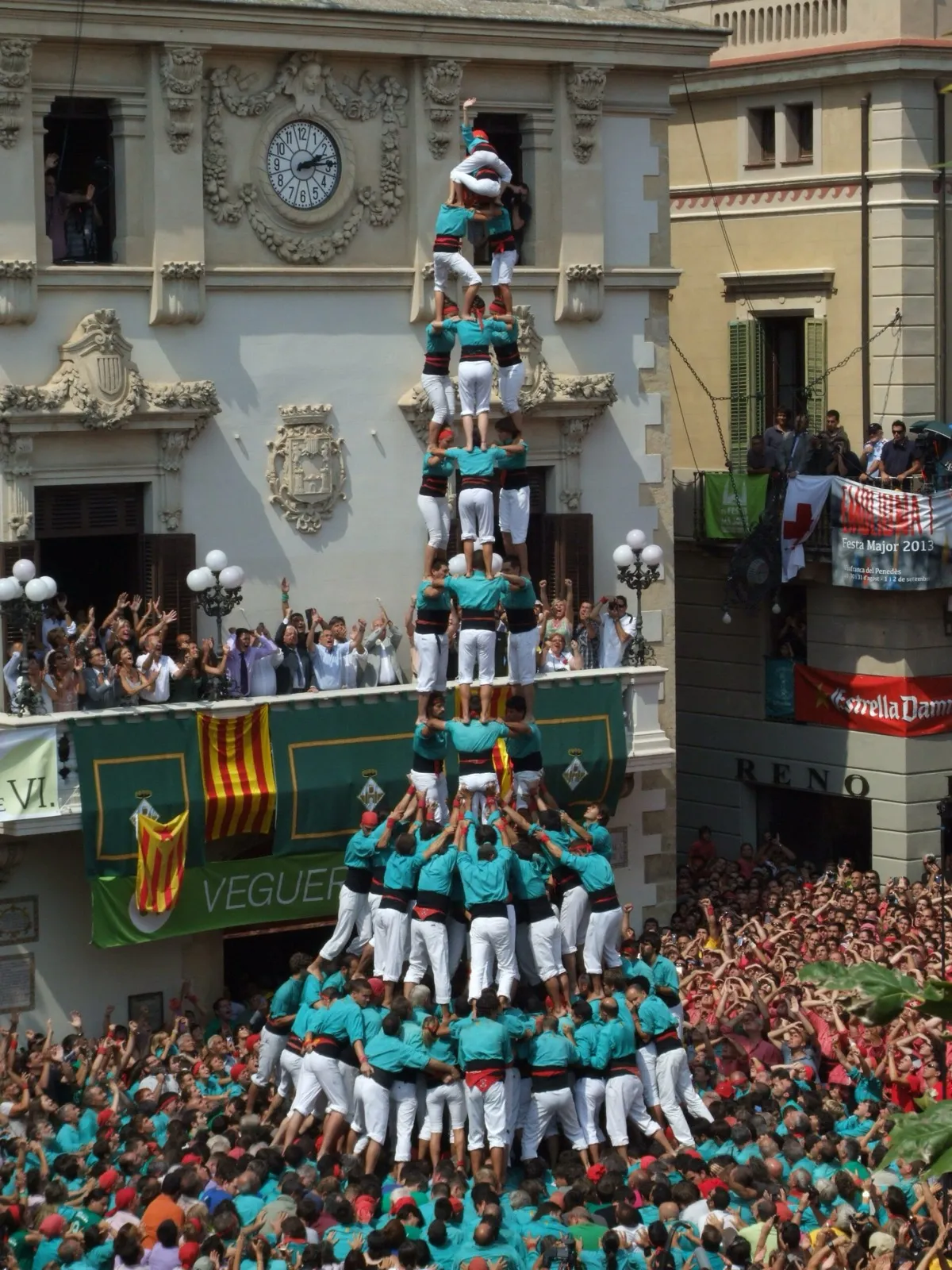
From the 1990s onward, the casteller world entered a period of record-breaking achievements and rapid growth. In 1998, Minyons de Terrassa successfully completed the first 3 de 10 amb folre i manilles, the first ten-storey castell ever fully completed. In 2015, the same colla also completed the first 4 de 10 amb folre i manilles. Every new technical breakthrough showed that the limits of what was possible were much farther away than anyone had imagined.
In 2010, UNESCO inscribed castells on the Representative List of the Intangible Cultural Heritage of Humanity during a ceremony held in Nairobi, Kenya. That decision gave international visibility to a tradition that now also has stable colles outside Catalonia, in cities such as Paris, Brussels, London and Berlin. Castells UNESCO Heritage →
The numbers speak for themselves: today the casteller world brings together more than one hundred colles across the Catalan-speaking territories, around 13,000 registered members and more than 12,000 castells every year. What began as one element within a local dance has become a major cultural movement.
Castells today: living tradition
Castells in the 21st century reflect Catalan society as it is today: diverse, open and dynamic. Today's colles include people of all ages, backgrounds and circumstances. In many of them, castellers born in Catalonia work side by side with people from Morocco, Latin America, sub-Saharan Africa or Asia. The pinya, the base of the castell, is also a perfect metaphor for the society that builds it: everyone is necessary and everyone has a place. Regular coverage by TV3 and the 3cat platform has brought castells into hundreds of thousands of homes, consolidating them as one of the country's most followed spectacles.
Beyond town squares, castells have found new spaces: corporate events, international celebrations and cultural festivals. Companies from around the world hire casteller performances as team-building experiences or as a unique show for their clients. That projection does not dilute the tradition; it strengthens it. Every new place where a castell is raised is an opportunity to tell a 200-year story of trust, effort and community. Book castells for your event →