Castells Glossary: all the terms you need to know
This guide gathers the essential vocabulary of the casteller world so you can understand every moment of a performance. Whether you are watching castells for the first time or organising an event with castellers, you will find the terms you need here: from the parts of the structure to the roles inside it, the different types of castells and the music that accompanies them.
Castell Structure
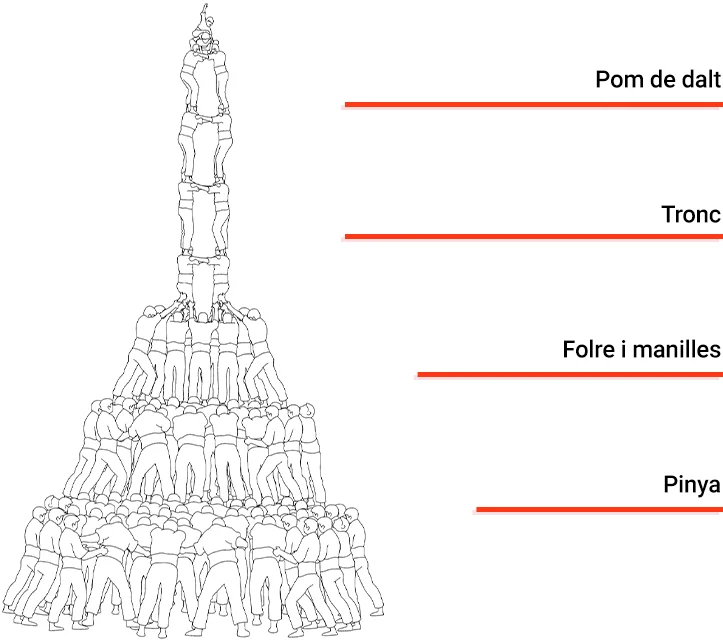
- Pinya
- The compact base made up of dozens of people standing close together to form a solid block. It has a double role: providing structural support to the trunk and acting as a safety cushion if the castell falls. In larger castells, extra layers such as the folre and manilles are added.
- Folre
- A second support layer placed above the pinya. It is needed for 8-storey castells and above, because the pinya alone cannot absorb all the weight. It helps distribute the load and adds stability to the structure.
- Manilles
- A third reinforcement layer placed above the folre. It is only used in the tallest and most difficult castells, usually 9- and 10-storey structures.
- Tronc (trunk)
- The central and visible body of the castell, formed by the levels of castellers standing above the pinya. The number of people per level gives the structure its name: pilar, torre, tres or quatre.
- Pom de dalt
- The crown of the castell, made up of three levels: the dosos, the acotxador and the enxaneta. In castells that have a pom de dalt, this crowning keeps the same basic structure regardless of height.
Casteller Positions
- Enxaneta
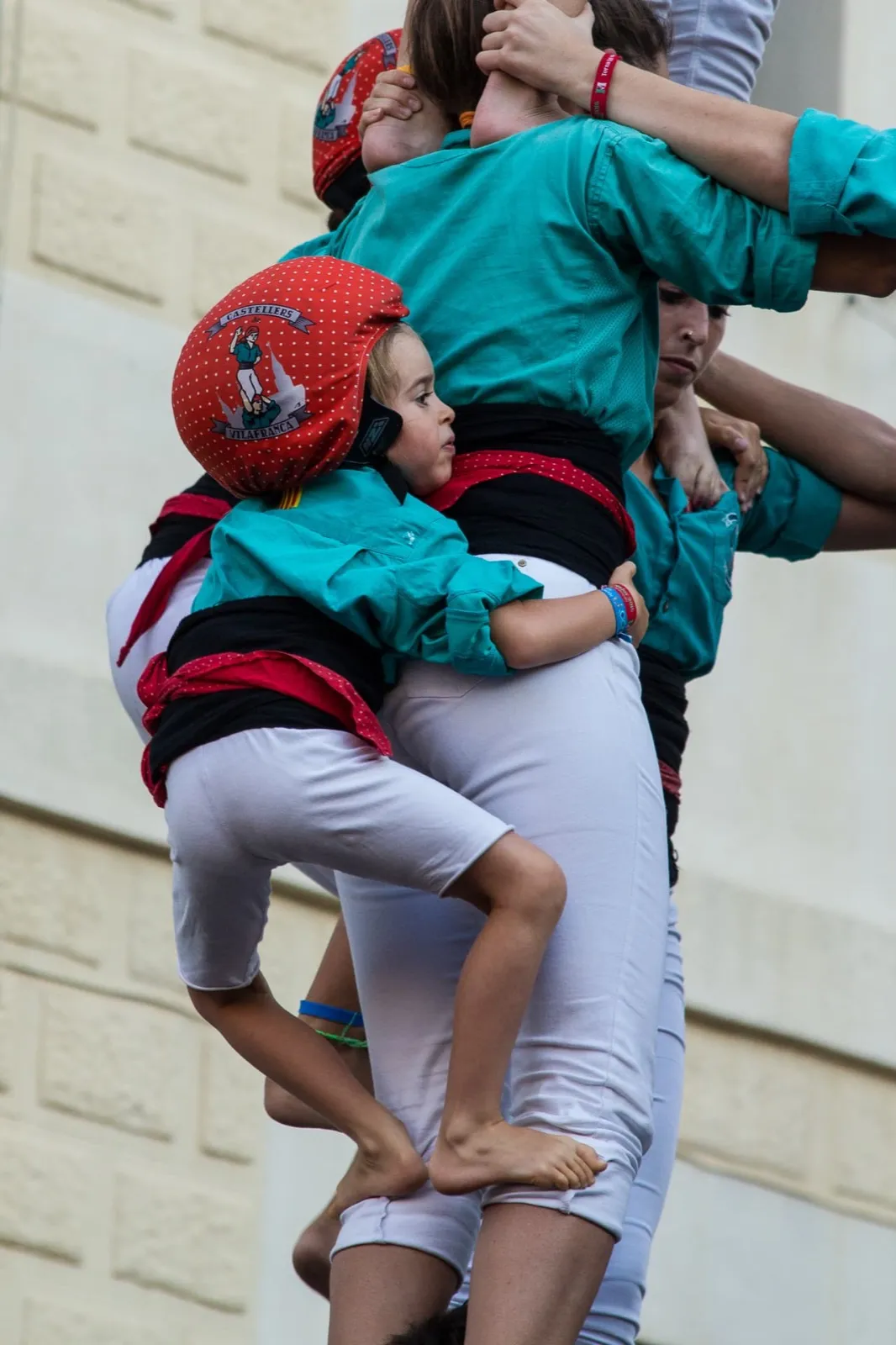
- The child who crowns the castell by climbing to the very top. When they raise their hand, the castell is considered loaded. Traditionally, the enxaneta is one of the lightest and youngest members of the colla.
- Acotxador
- The casteller who crouches on top of the dosos. This role creates the platform that allows the enxaneta to climb to the top. It requires agility and excellent balance.
- Dosos
- Two castellers who lock arms to form the base of the pom de dalt. Their name comes from the fact that they are always exactly two, whatever the type of castell.
- Aixecador
- Another name for the acotxador used in much of the casteller world. It refers to the casteller positioned above the dosos and just below the enxaneta, one step away from completing the crown of the castell.
- Baix
- The casteller on the first level of the trunk, directly above the pinya. This role must be strong and resilient, as it bears the weight of the entire vertical structure built above.
- Cap de colla
- The technical and strategic leader of the colla. This person decides which structures will be attempted at each performance, directs weekly rehearsals and coordinates how all castellers are positioned.
Types of Structures
- Pilar
- A structure with one person per level. It is the simplest form but also one of the hardest to complete, because balance depends entirely on a single casteller on each level. Common variants are the pilar de 4, 5 and 6.
- Torre
- A castell with 2 people per level, also known as a dos. It is more stable than a pilar because the two castellers on each level can support one another. Variants include the torre de 6, 7, 8 and 9.
- Tres
- A castell with 3 people per level. It is a demanding structure that requires excellent coordination. Variants include the 3 de 7, 3 de 8, 3 de 9 and the 3 de 10, one of the highest-difficulty structures in the repertoire.
- Quatre (four)
- A castell with 4 people per level, the most common structure in performances. Its wider base allows very tall constructions to be built with relative stability. Variants include the 4 de 7, 4 de 8, 4 de 9 and 4 de 10.
See the full guide to types of castells →
Nomenclature
- Colla castellera
- A group of people devoted to building castells. Every colla has its own name, colours and identity. Today the casteller world brings together more than one hundred colles across the Catalan-speaking territories and around 13,000 registered members.
- Diada castellera
- A festive day on which colles perform castells in a town square. Diades are usually linked to local festivals and are the moment when castellers show the results of their rehearsal work.
- Loaded
- The state of a castell once the enxaneta has reached the top and raised a hand. From that moment, it still has to be dismantled safely to count as fully successful.
- Unloaded
- The state of a castell when, after being loaded, it is dismantled completely without collapsing. This is the perfect outcome for a castell.
- Attempt
- A castell that collapses during construction. The pinya works as a safety cushion to protect the castellers.
- Dismantled attempt
- A castell that is not completed but is taken down in a controlled way without collapsing. It is considered neither a success nor a failure.
- Fer l'aleta
- The gesture made by the enxaneta when they reach the top of the castell and raise a hand. It marks the moment when the castell becomes loaded.
Music and Culture
- Gralla
- A traditional Catalan double-reed wind instrument. Its powerful, piercing sound can be heard from hundreds of metres away, which makes it ideal for town squares where castells are built. Two main variants exist: the gralla seca, older and without keys, and the gralla dolca, with keys and greater versatility.
- Timbal
- A percussion instrument that marks the rhythm alongside the gralla. The classic musical formation accompanying casteller performances usually consists of 2 or 3 gralles and 1 timbal.
- Toc de castells
- The specific tune played during each phase of a castell. It works as a communication system: castellers who cannot see the structure know what is happening thanks to the changes in the melody.
- Concurs de Castells
- The major casteller competition whose first edition was held in Tarragona in 1932, with Pau Casals as jury president, and which today stands as the flagship biennial event of the casteller calendar.
History of the Concurs de Castells →